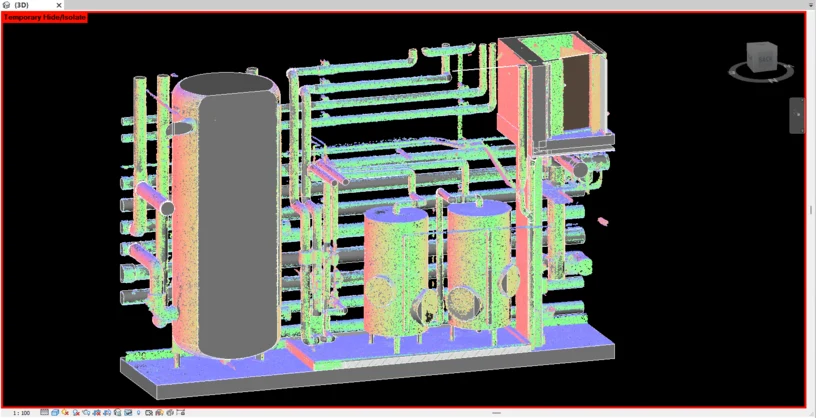
In the modern construction and architecture industry, accuracy and reliability are critical for project success. Scan-to-BIM workflows depend heavily on precise existing-condition data to create dependable Building Information Models. Traditional survey methods often introduce errors, delays, and rework. This is where 3D Laser Scanning plays a key role in improving Scan-to-BIM accuracy.
What Is 3D Laser Scanning?
3D Laser Scanning is an advanced reality capture technology used to measure buildings and sites with extreme precision. Laser scanners emit millions of laser beams that hit surfaces and return accurate distance data. This information is processed into a high-density point cloud, which represents the exact geometry of the scanned structure.
These point clouds are then converted into BIM models using software like Revit, ensuring that the digital model matches real site conditions.
Why Accuracy Matters in Scan-to-BIM Projects
Scan-to-BIM projects are widely used for renovation, retrofit, facility management, and as-built documentation. Even small inaccuracies in measurements can lead to:
- Design clashes
- Construction delays
- Costly rework
- Poor coordination between teams
By using laser-based reality capture, project teams can eliminate guesswork and base decisions on reliable, site-verified data.
How 3D Laser Scanning Improves Scan-to-BIM Accuracy
- High-Precision Data Collection
Laser scanning technology captures millions of data points with millimeter-level accuracy. Architectural, structural, and MEP elements are recorded exactly as they exist, resulting in highly reliable BIM models.
- Complete Site Coverage
Unlike manual surveys, this technology captures full-site geometry, including hard-to-access and complex areas. This ensures no critical detail is missed during the modeling process.
- Reduced Human Error
Manual measurements rely on human judgment, which increases the risk of mistakes. Automated scanning significantly reduces errors and improves overall model quality.
- Improved Clash Detection
Accurate BIM models created from 3D Laser Scanning allow early detection of clashes between systems. Identifying conflicts during design saves time and prevents costly changes during construction.
- Accurate Modeling of Complex Structures
Renovation projects, heritage buildings, and industrial facilities often have irregular geometry. Laser-based scanning captures these complex shapes with exceptional precision, ensuring the BIM model reflects true site conditions.
Benefits of Using 3D Laser Scanning for Scan-to-BIM
Accurate point cloud data plays a crucial role in successful Scan-to-BIM projects. High-quality scan data helps teams understand true site conditions, dimensions, and spatial relationships. This reduces design assumptions and ensures BIM models are aligned with real-world geometry, especially in renovation and retrofit projects.
- Faster Project Delivery with fewer site visits
- Lower Project Costs due to reduced rework
- Better Team Coordination across disciplines
- Higher Client Confidence through accurate models
- Reliable As-Built Documentation for long-term use
Advanced scanning technology also helps reduce site visits and improves overall safety. Once the site is digitally captured, teams can perform measurements and verifications remotely. This saves time, lowers project risks, and allows better planning in complex or restricted site environments.
Applications of 3D Laser Scanning in Scan-to-BIM
- Commercial and office buildings
- Residential developments
- Industrial plants and warehouses
- Hospitals and healthcare facilities
- Airports and infrastructure projects
- Renovation and retrofit projects
In every case, accurate data leads to smoother execution and better project outcomes.
Role of 3D Laser Scanning in BIM Levels of Detail
- LOD 200–300: Accurate base models for planning and design
- LOD 400: Detailed coordination and fabrication-ready models
- LOD 500: Precise as-built models for facility management
Why 3D Laser Scanning Is the Future of Scan-to-BIM
As the construction industry moves toward digital transformation, clients demand data-driven and clash-free BIM models. 3D Laser Scanning delivers unmatched precision, faster workflows, and future-ready documentation.
It is not just a technology upgrade—it is a strategic advantage for modern Scan-to-BIM projects.
Conclusion
Improving Scan-to-BIM accuracy with 3D Laser Scanning results in better planning, reduced risks, and higher project success rates. By capturing real-world conditions with exceptional precision, this technology bridges the gap between physical sites and digital BIM models.
In short, 3D Laser Scanning ensures accuracy, confidence, and long-term value in every Scan-to-BIM project.


